

Enterprise governance and smart city illustration
Municipal Government

Governing a smart city's dataacross 12 departments.

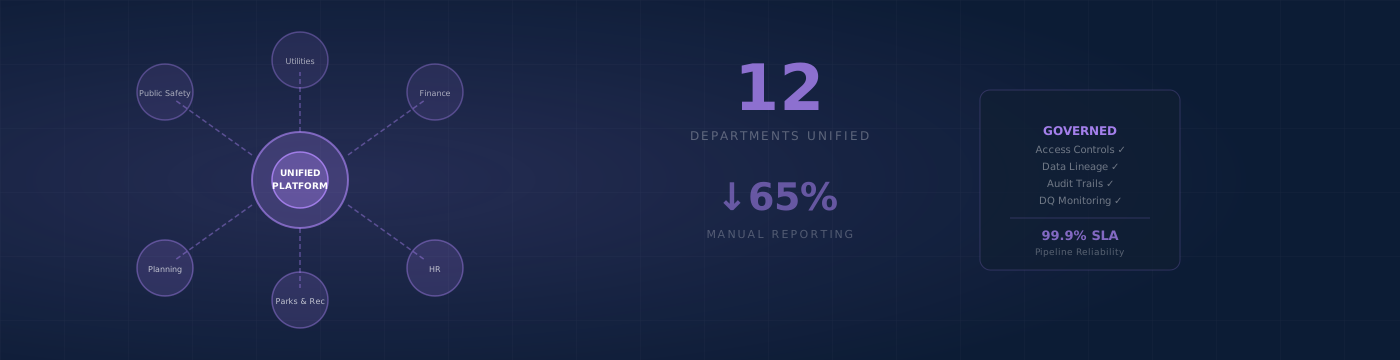
12

City departments on one governed platform

↓65%

Reduction in manual reporting overhead

99.9%

Pipeline reliability SLA achieved

AI-Ready

Smart city AI initiatives now enabled

The Situation

Our client is one of the fastest-growing municipalities in America — and its data operation was struggling to keep pace. With over 200,000 residents and rapid expansion across residential, commercial, and infrastructure development, the city's departments were generating more data than ever before. But that data was siloed, inconsistently managed, and largely inaccessible to city leadership as a unified resource for decision-making.

The city's leadership had a clear ambition: become a smart city — using data and AI to improve public safety response times, optimize utility operations, predict infrastructure maintenance needs, and deliver better services to residents. The data foundation to support any of that didn't exist yet.

* This engagement is representative of the work DataWalkers performs for municipal government clients.

The Complication

Twelve city departments — Public Safety, Utilities, Finance, Planning & Development, Parks & Recreation, Human Resources, and more — each operated their own reporting systems with no shared data definitions, no unified data catalog, and no way to produce cross-department analysis for city leadership.

Department analysts were spending the majority of their time manually pulling, cleaning, and consolidating data for regular operational reports — work that should have been automated years ago. When the same metric was reported differently by two departments in the same council meeting, it eroded trust in the data and created friction that slowed decisions.

Governance was effectively informal. Access controls were managed through ad hoc processes. There were no systematic audit trails. For a municipality required to produce compliance reports, certify data for grant applications, and meet public records obligations, this was significant exposure. And with smart city AI on the roadmap, the data foundation was simply not ready.

  • Public Safety
  • Utilities & Infrastructure
  • Finance & Budget
  • Planning & Development
  • Parks & Recreation
  • Human Resources

"For the first time, our department heads are looking at the same numbers. DataWalkers gave us one version of the truth — and the governance to trust it."

Chief Information Officer · Municipal Government Client

The Solution

DataWalkers designed and built a unified, governed analytics platform spanning all 12 city departments — replacing siloed reporting systems with a single source of truth, automated pipelines, and an enterprise governance framework built for municipal compliance requirements.

We began with a full assessment of each department data sources, reporting workflows, and governance posture — mapping the gaps between current state and what a smart city AI platform would require. From that foundation, we built standardized data models shared across all departments, with common metric definitions that made cross-department reporting consistent and trustworthy.

Automated pipeline orchestration replaced manual data pulls across every department — with scheduled delivery, data freshness guarantees, and self-healing logic that caught failures before they surfaced in council reports. Role-based access controls, data lineage tracking, and audit trail generation were implemented systematically across the full platform — not as a compliance afterthought, but as first-class infrastructure from day one.

With clean, governed, automated data flowing across 12 departments, we conducted an AI readiness assessment and defined the roadmap: predictive maintenance for utilities infrastructure, traffic pattern analysis for public safety, and resource optimization for parks and facilities — all now achievable on the platform we built.

The Impact

For the first time, every department head in the city government saw the same numbers in the same report, calculated the same way, from the same governed data source. Manual reporting overhead fell sharply. Pipeline reliability reached 99.9%. And the governance framework that had been missing for years was now embedded into the platform's operational fabric.

  • 12City departments unified on one governed analytics platformSiloed systems, inconsistent definitions, and manual consolidation replaced by a single source of truth across all city operations.
  • ↓65%Reduction in manual reporting overheadAutomated pipelines and scheduled delivery freed department analysts from data wrangling — time redirected to analysis and planning.
  • 99.9%Pipeline reliability SLA achieved post-automationMonitoring, alerting, and self-healing pipeline patterns eliminated the silent failures that previously surfaced in council meetings.
  • AI-ReadySmart city AI roadmap now executablePredictive maintenance, traffic optimization, and resource planning AI initiatives unblocked by a governed, quality-certified data foundation.

See what DataWalkers can do for your team.